Independent study · Carleton
Experience strategy / Concept validation
Experience strategy for ad-supported listening
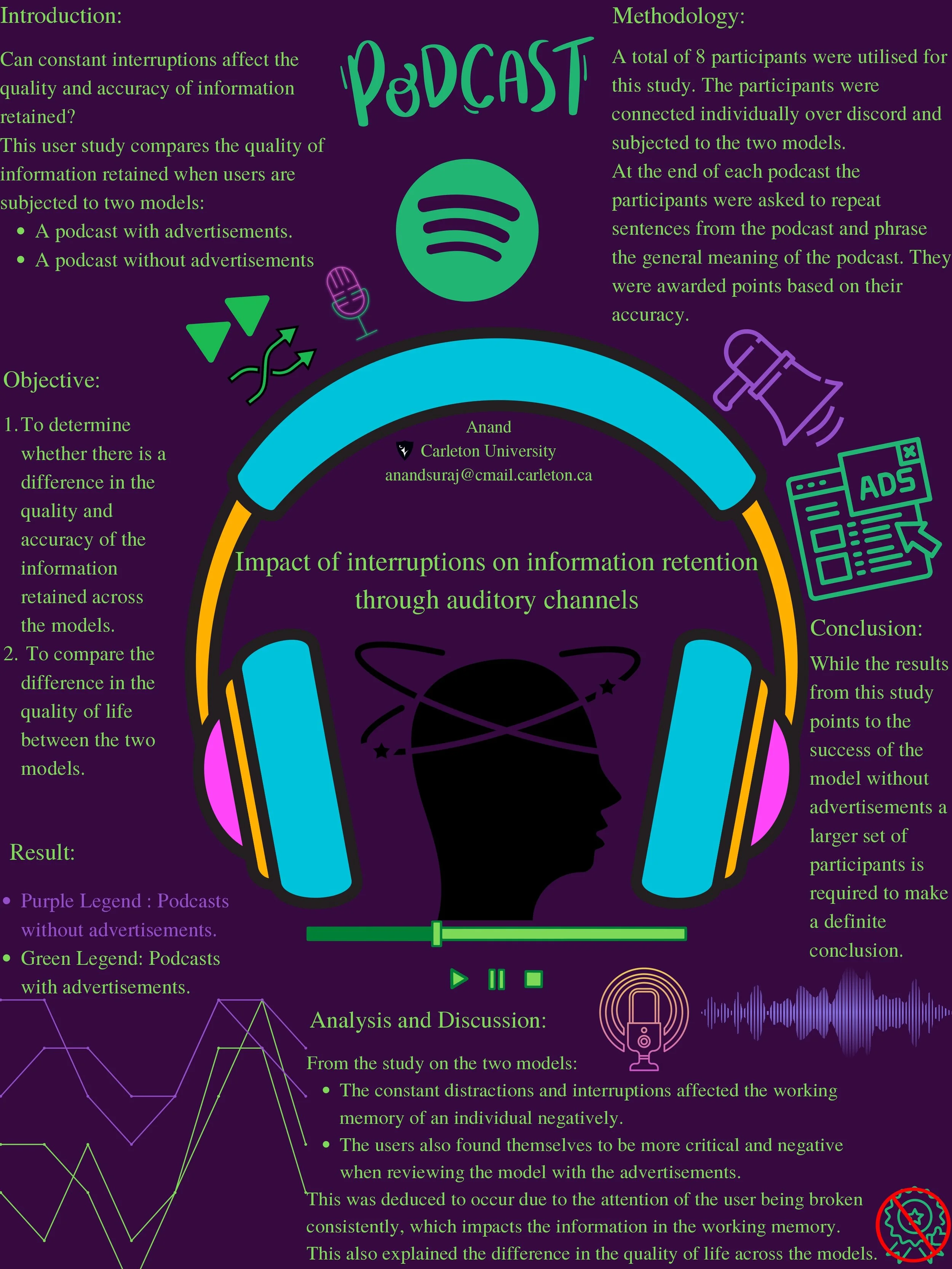
The problemAd-supported listening must balance monetization with a listener’s flow. My question: could predictable interruptions protect that flow better than standard ad breaks? This was an independent academic study using a Spotify-style context, not work for Spotify.
My contributionA design-led listening flow with predictable interruptions, compared in an 8-participant concept study.
Experimental listening conditions
3
No ads, standard ads and UX-informed placement.
Listening baseline
No ads / standard ads
Predictable ad moment
UX-informed placement
Recall & satisfaction
Compare concept conditions
- My role
- UX research & visual design
- Team
- Independent academic study participants
- Timeline
- 2023
- Tools
- Concept prototyping, Comparative research
Independent academic listening study exploring ad-supported experience design.
Process
The work behind the decisions.
- 01
Establish realistic baselines
Framed three exposure conditions: no ads, standard ads and UX-informed ad placement, informed by Spotify’s listening context.
- 02
Prototype predictable ad moments
Explored timing and relevance of placement to preserve listening flow while considering the ad-supported business model.
- 03
Compare recall and satisfaction
An eight-participant podcast recall comparison examined recall and reported satisfaction across the concept conditions.
Key decisions
Design decisions that shaped the experience.
Make interruptions predictable
Use considered ad moments to explore a listening experience with fewer unexpected interruptions.
Trade-off
The concept still needs to account for the realities of ad-supported monetization.
Compare against a realistic baseline
Include standard ads and no ads so concept feedback can be interpreted in context.
Trade-off
An eight-participant concept comparison informs design direction, not commercial retention claims.
Design value & supporting evidence
Experience strategy for ad-supported listening
The small concept comparison reported differences in podcast recall and satisfaction, informing ad-placement strategy rather than a shipped product lift.
- Study participants
- 8
- Small concept study of the listening journey.
- Ad recall difference
- 30%
- Recall difference reported in the small concept study.
- Satisfaction difference
- 50%
- Satisfaction difference reported in the small concept study.
Reflection
The next test would check whether predictable ad moments preserve recall across longer sessions and a larger participant group.
Next case study
HUD information hierarchy for competitive FPS games
A conceptual comparison of VALORANT, Counter-Strike and Overwatch HUDs, exploring glanceable signal priority.
View case studyCritical signals
Health and objectives
Spatial hierarchy
Stable priority positions
Layout concepts
Glanceable status and alerts